
 Set as preferred source


Fundraising has never been easy - but in 2026, it has become more complex. Despite global access to capital and a growing investor ecosystem, founders now operate in a more constrained environment.
Geopolitical fragmentation, tighter capital flows, and the regionalization of venture markets have reshaped how capital moves. Cross-border investments face more scrutiny, capital is concentrating in fewer hands, and decision cycles are getting longer.
The implication is clear: capital is still available - but it is harder to access, slower to secure, and more competitive to win. In this environment, fundraising has become an operational challenge.
This shift is driving the emergence of fundraising platforms - tools designed to structure investor pipelines, centralize communication, and enable data-driven fundraising.
The challenges of traditional startup fundraising
To understand today’s challenges, it’s important to recognize how traditional fundraising was structured - and why that model no longer scales in 2026.
Historically, fundraising was primarily relationship-led and only lightly structured. Founders worked with relatively small, curated groups of investors, relied heavily on warm introductions, and managed a limited number of conversations in parallel. In that context, informal processes were sufficient. Capital moved faster, competition was lower, and decision-making within funds was less complex.
That environment has changed.
In 2026, fundraising operates as a multi-threaded, process-intensive system. Founders are expected to manage dozens of investor interactions simultaneously, often across multiple stakeholders within each fund. Decision cycles are longer, diligence is deeper, and competition for capital is significantly higher. What was once a manageable set of relationships has evolved into a complex, time-sensitive process that requires coordination, consistency, and visibility.
Traditional approaches begin to break down:
- Without structured outreach, founders struggle to prioritize the right investors and allocate time efficiently.
- Communication becomes fragmented across channels, making it difficult to maintain context.
- The absence of a clear pipeline limits visibility into deal progression.
- Inconsistent follow-ups reduce momentum and conversion.
- The lack of data and feedback loops prevents performance optimization.
As complexity increases, these inefficiencies compound. Founders spend more time managing the process than controlling it, and outcomes become increasingly dependent on execution quality rather than underlying fundamentals.
This is the core limitation of traditional fundraising: it was not designed for the scale, speed, and process discipline required in today’s capital environment.
What is a fundraising platform?
A fundraising platform is a software system designed to structure, manage, and optimize the process of raising capital.
At its core, it functions as a specialized investor CRM, but with additional layers tailored specifically to how fundraising actually works in practice.
Unlike generic tools such as spreadsheets or standard CRMs, fundraising platforms are tailored to the realities of venture fundraising:
- multiple parallel investor conversations
- defined deal stages (intro, meeting, diligence, term sheet)
- time-sensitive follow-ups
- multi-stakeholder decision processes
As a result, they allow founders to operate fundraising as a coordinated process rather than a set of disconnected activities.
It is important to distinguish this from the nonprofit context.
In charity fundraising, platforms like GoFundMe or JustGiving are designed to collect and manage donations. In contrast, startup fundraising platforms focus on managing investor relationships and closing investment rounds, where each interaction is part of a longer, more complex decision cycle. Examples of this category include tools like Affinity, Foundersuite, or Visible, which combine CRM functionality, pipeline tracking, and investor updates into a single system.
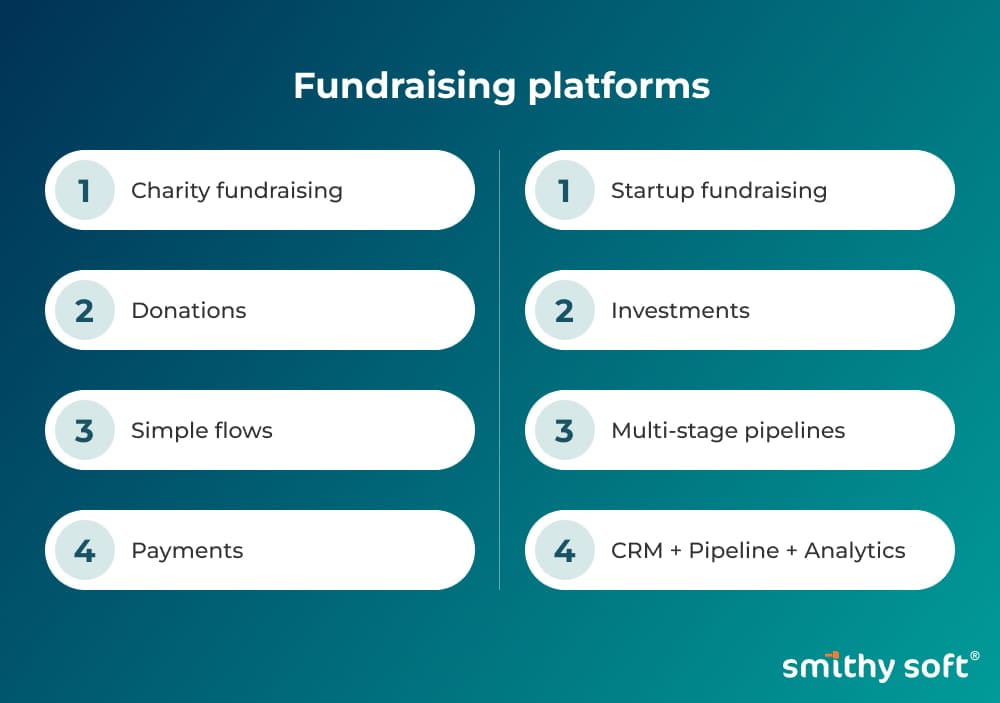
In practice, a fundraising platform transforms fundraising from manual coordination into a trackable, data-driven process - bringing the same level of structure that modern sales teams apply to revenue generation.
How fundraising platforms help startups raise capital
Fundraising platforms impact outcomes by improving three critical variables: conversion, speed, and coverage.
- They increase conversion rates across the funnel.
By structuring the process into clear stages and enforcing consistent follow-ups, startups reduce drop-offs between steps. More first meetings convert into second meetings, more conversations progress into diligence, and more diligence processes result in term sheets. In practical terms, this means that from the same number of investor contacts, startups close more deals.
- They expand effective investor coverage.
Instead of managing a limited number of conversations, founders can handle 50–150+ targeted investors in parallel without losing control. This increases the probability of finding the right investor fit and creates competitive tension - both of which directly improve the chances of closing a round and often lead to better terms.
- They shorten time-to-close.
Centralized communication, clear next steps, and automated follow-ups reduce delays between interactions. Faster cycles help maintain investor momentum and reduce the risk of losing interest or missing market windows.
- They also improve capital allocation efficiency during the process.
With full pipeline visibility, founders can quickly identify which investors are progressing and focus their time accordingly - rather than spreading effort evenly or reactively.
- Finally, they enable better signaling.
Consistent updates, structured communication, and visible momentum across the pipeline create stronger perception among investors. In competitive rounds, this signaling effect can influence decision speed and commitment.
In combination, these effects are compounding: more conversations → higher conversion → faster cycles → stronger competition → better outcomes.
As a result, fundraising platforms do not just make the process easier—they directly increase the likelihood, speed, and quality of capital raised.
Key features of modern fundraising platforms
Modern fundraising platforms are designed around a single practical goal: to give founders control over dozens of investor conversations at once.
This is achieved through a set of capabilities that directly impact day-to-day execution.
- Centralized investor workspace: instead of managing investors across spreadsheets and inboxes, everything is stored in one place. In practice:
- a founder can open an investor profile and see the full history—introductions, emails, notes, meetings
- the entire team works from the same context
- no information is lost across channels
- Visual fundraising pipeline: each investor is mapped to a specific stage - outreach, meeting, diligence, term sheet. The process becomes visible and manageable. This allows founders to clearly see:
- how many investors are actively engaged
- where conversations are stalled
- where immediate action is needed
- Built-in follow-up control: the platform highlights who needs a follow-up and when. In practice:
- no missed or delayed responses
- consistent communication timing
- fewer conversations lost due to inactivity
This directly improves conversion across stages.
- Investor segmentation and prioritization: investors can be filtered by stage, ticket size, sector, or geography. This enables founders to:
- focus on high-probability investors
- avoid low-fit outreach
- tailor communication more effectively
- Real-time pipeline visibility: founders get a clear, up-to-date view of the round. They can quickly identify:
- where progress is happening
- where deals are slowing down
- which investors require attention
- which conversations are no longer viable
This supports faster and better decision-making.
- Integrated communication: email and calendar integrations ensure that all interactions are automatically captured. This means:
- no manual logging
- consistent tracking of all communication
- reduced operational overhead
- Data and performance insights: platforms provide visibility into funnel performance:
- how many outreaches convert into meetings
- how many meetings progress to diligence
- where drop-offs occur
This helps answer a critical question: is the issue in the startup - or in the process?
Why fundraising platforms are becoming essential for startups
Most startups today do not fail to raise capital because they lack a strong product or vision. They fail because they cannot manage the volume, timing, and coordination required to run a modern fundraising process.
A typical round now involves 70-150 targeted investors, each with different timelines, internal decision processes, and expectations. One missed follow-up can delay a conversation by weeks. One lost thread in an email chain can reset context with a partner. One poorly timed update can kill momentum. These are not edge cases - they are daily operational risks.
Without a system, founders face very concrete problems: they cannot track who is waiting for a response this week, they lose visibility on which investors are actually progressing vs. passively engaging, they spend time on low-probability conversations instead of advancing real opportunities, they fail to create momentum across multiple investors at the same time.
This is where fundraising platforms become critical.
They solve coordination at scale. Instead of reacting to inbound emails and scattered notes, founders operate from a system that shows: who needs attention today, which deals are moving forward, where the pipeline is weakening.
They also enforce timing discipline. Follow-ups happen when they should, updates are consistent, and no conversation goes cold unintentionally. This alone has a direct impact on conversion.
Just as importantly, they enable momentum management. Founders can align conversations, create parallel progress, and move multiple investors through the funnel at the same pace - something that is nearly impossible to do manually.
Finally, they improve decision quality during the process. With visibility into the pipeline, founders can double down on high-conviction investors and deprioritize stalled ones, instead of spreading effort evenly.
In 2026, these capabilities are not optimizations - they are requirements.
Fundraising platforms are becoming essential because they are the only practical way to do that at scale.
How software development expertise matters in building fundraising platforms
Building a fundraising platform is not about assembling standard SaaS features. It requires solving a very specific problem: how to manage dozens of time-sensitive investor interactions without losing momentum.
At a foundational level, a fundraising platform must accurately reflect how fundraising works in reality. Unlike traditional sales pipelines, fundraising is non-linear: multiple investors move at different speeds, conversations restart, stakeholders change, and deal status evolves dynamically. Designing systems that can handle this requires strong product thinking and flexible architecture - not rigid, predefined workflows.
Another layer of complexity comes from communication. Fundraising happens across email threads, introductions, meetings, and internal notes. Bringing all of this into a single, reliable system requires deep integration expertise - particularly with tools like Gmail, Outlook, and calendars. It’s not just about connecting APIs, but ensuring data consistency, correct threading, and real-time synchronization without duplication or data loss.
User experience is equally critical. Founders operate under time pressure and need immediate clarity - what’s happening in the pipeline, who needs a response, where momentum is building or slowing. This demands fast, intuitive interfaces and well-structured data presentation. Poor UX doesn’t just reduce usability - it leads to missed follow-ups and lost opportunities.
In parallel, the platform must ensure reliability and trust. Investor data, deal progress, and internal notes are sensitive and must be consistently accurate across users and devices. This requires robust backend architecture, strong data models, and carefully designed synchronization mechanisms.
Finally, advanced platforms go beyond tracking and introduce analytics - conversion rates, deal velocity, pipeline health. Building this layer requires not just frontend dashboards, but a well-structured data foundation capable of supporting real-time insights and decision-making.
SmithySoft experience
At Smithysoft, we have practical experience building fundraising and investor management platforms, including work on products like Foundersuite - a platform used by over 30,000 startups and hundreds of venture funds.
This experience gives us direct insight into how fundraising actually operates in practice: multi-stage pipelines, parallel investor conversations, and time-sensitive communication.
We design and develop:
- investor CRM and deal flow systems
- fundraising pipelines with real-world stages
- integrations with email and calendar tools
- data and reporting layers for tracking pipeline performance
Because these systems are used during active fundraising rounds, our focus is on reliability, visibility, and execution speed - not just feature completeness.
If you are building a fundraising platform, we can help you design and develop a system that is reliable, scalable, and ready for real-world fundraising execution!