
 Set as preferred source


Until recently, the internet operated on a simple assumption: digital interactions were presumed to be authentic unless proven otherwise. A photo was treated as evidence, a voice recording implied a real speaker, a video suggested a real event, and an email likely came from a human being.
Today, generative AI is dismantling that assumption at global scale.
Synthetic media is no longer experimental. Voice cloning, AI-generated video, automated impersonation, and synthetic identities have become real-world infrastructure, dramatically reducing the cost of deception. Nearly everything is now subject to doubt. Trust is eroding, and authenticity can no longer be assumed by default.
This is not simply a content problem. It is an infrastructure problem.
As a result, the next era of technology will increasingly be shaped not around content creation - but around verification and authenticity.
The collapse of trust economics
For decades, the digital economy relied on an invisible assumption: verifying identity was relatively cheap, while large-scale impersonation was expensive. Fraud required infrastructure: call centers, human operators, coordinated phishing campaigns, fake documents, social engineering teams.
That equation is breaking down.
In 2026, generative AI dramatically compresses the cost of deception while simultaneously increasing the cost of verification. This changes the economics of the internet itself.
Voice synthesis can imitate executives in seconds. AI-generated avatars can participate in live meetings. Synthetic identities can automate fraud across banking systems, hiring platforms, ecommerce, healthcare, and enterprise collaboration tools.
When any digital interaction can be synthetically generated, trust itself becomes expensive.
Real examples already reshaping the market
1. Deepfake CEO fraud
One of the clearest examples of the new AI fraud economy emerged in February 2024, when attackers used deepfake technology during a live video conference to impersonate senior executives of a multinational company in Hong Kong.
According to Hong Kong police, an employee was invited to a video meeting that appeared to include the company’s CFO and several colleagues. Every participant looked and sounded legitimate. During the call, the employee was instructed to authorize multiple transfers totaling approximately $25 million.
The executives on the call were not real. Attackers had used AI-generated video and voice simulation to create convincing synthetic versions of the company’s leadership team. What makes this case important is not only the scale of the fraud, but the attack model itself.
No malware was deployed. No infrastructure was technically breached. No password was stolen.
The attack succeeded because identity itself became unreliable.
This marked a major shift in cybersecurity and enterprise risk: AI fraud was no longer limited to phishing emails or fake documents. It had evolved into real-time identity simulation capable of bypassing human trust during live interactions. The attack surface is no longer only software. It is human perception itself.
2. Synthetic employees inside IT outsourcing and remote teams
Security firms increasingly warned in 2025-2026 about coordinated campaigns involving synthetic IT workers.
Attackers used:
- fabricated LinkedIn histories,
- AI-generated profile photos,
- synthetic interview participation,
- stolen or modified identities
- to gain access to enterprise systems through remote employment.
In some cases, the goal was financial fraud. In others, intelligence gathering or long-term infrastructure access.
This became especially concerning for outsourced development, remote engineering teams,
DevOps access, enterprise support operations. The risk was no longer merely “fake resumes.” It was unauthorized infrastructure access through synthetic humans.
3. Election integrity and AI manipulation
During the 2024 US election cycle, AI-generated robocalls imitating President Joe Biden circulated in New Hampshire, discouraging voters from participating in the primary election.
The incident triggered: FCC intervention, increased state-level deepfake legislation, expanded pressure on telecom providers and AI platforms.
Shortly afterward, the FCC formally ruled that AI-generated voices in robocalls can be treated as illegal under the Telephone Consumer Protection Act (TCPA).
This marked one of the first major US regulatory actions directly targeting AI-generated impersonation.
4. AI-generated lawyer impersonation
By 2026, several US law firms and corporate legal departments reported incidents involving AI-generated voice impersonation during urgent financial or contractual negotiations.
In multiple cases, attackers cloned the voices of partners or executives to pressure employees into:
- changing payment details,
- approving wire transfers,
- sharing confidential documents.
The attacks were particularly effective because they exploited trust in familiar voices rather than technical vulnerabilities.
For many enterprises, this shifted cybersecurity concerns from “system compromise” toward “identity authenticity.”
5. AI-generated customer support fraud
Banks and ecommerce platforms increasingly reported cases where fraudsters used AI voice systems to impersonate customers during support calls.
Traditional verification methods such as:
- voice recognition,
- date of birth,
- basic identity questions
- became less reliable against AI-assisted impersonation.
As a result, financial institutions expanded behavioral biometrics, liveness detection, device trust scoring, and continuous authentication systems.
This represents a major shift: authentication is moving from static identity checks toward ongoing behavioral verification.
6. AI-generated celebrity and brand impersonation
Major brands and public figures increasingly faced AI-generated impersonation scams involving: cloned voices, fake endorsements, synthetic interviews, fraudulent investment promotions.
This accelerated legal pressure around: digital likeness rights, AI disclosure laws, biometric protections, platform accountability.
The economic issue extends beyond reputational harm. When synthetic endorsements scale cheaply, trust in advertising and public communication itself begins to erode.
7. Deepfake financial analysts and market manipulation
Regulators and trading firms increasingly raised concerns in 2025-2026 around AI-generated financial commentary and synthetic executive statements capable of influencing markets.
The fear is not simply fake news. It is real-time manipulation of earnings expectations, investor sentiment, executive communications, market-moving announcements.
For public companies, authenticity verification increasingly intersects with SEC disclosure obligations, investor relations, market integrity, and reputational risk.
Deepfakes are only the visible layer
Public discussion often focuses on deepfake videos because they are visually shocking. But deepfakes are only the most visible symptom of a much larger transition.
The deeper issue is that AI is destabilizing the trust primitives of the internet.
Modern digital systems were built around assumptions that humans generate content, initiate communication, and control identities. AI blurs each of those boundaries simultaneously.
The result is a growing “trust recession” across the digital economy.
Platforms require stronger onboarding. Financial institutions expand verification procedures. Enterprises introduce additional compliance layers. Authentication becomes more aggressive, invasive, and continuous.
The internet is optimized for speed and scale. AI forces it to optimize for authenticity.
Governments are already responding
The regulatory response is accelerating rapidly - especially in the United States and Europe.
EU AI Act
The European Union has moved the fastest through the EU AI Act, which is now entering operational enforcement phases.
The regulation introduces obligations around:
- disclosure of AI-generated content,
- labeling of deepfakes,
- documentation of high-risk AI systems,
- traceability requirements,
- human oversight mechanisms.
For companies operating in Europe, AI compliance is becoming part of core product architecture rather than optional governance. Key legal framework: EU Artificial Intelligence Act (EU AI Act).
This is especially important for:
- SaaS platforms,
- AI copilots,
- media platforms,
- fintech,
- enterprise automation systems.
The EU is effectively forcing companies to build verification and provenance systems directly into digital products.
FCC and AI voice fraud
In the United States, one of the strongest early federal responses came from the FCC after AI-generated robocalls imitating President Joe Biden circulated during the election cycle.
The FCC ruled that AI-generated voices used in robocalls can violate the Telephone Consumer Protection Act (TCPA). Key regulatory action: FCC Declaratory Ruling on AI-Generated Robocalls.
This was a major signal: AI impersonation is increasingly treated as telecommunications fraud and election infrastructure risk - not merely misinformation.
FTC expands enforcement against AI deception
By 2026, the Federal Trade Commission is no longer treating AI risks as hypothetical future concerns. Instead, the agency is actively applying existing consumer protection and impersonation laws to AI-enabled deception.
The core legal foundation remains Section 5 of the FTC Act, which prohibits unfair or deceptive acts or practices. In practice, this allows the FTC to pursue companies using AI to:
- mislead consumers,
- exaggerate AI capabilities,
- generate fake reviews,
- create synthetic endorsements,
- enable impersonation or deceptive automation.
A second major framework is the FTC Government and Business Impersonation Rule, which entered into force in 2024 and remains highly relevant in 2026.
The rule targets scams involving impersonation of:
- businesses,
- government agencies,
- customer support services,
- financial institutions,
- enterprise communication channels.
This becomes increasingly important as AI-generated voices, synthetic identities, and real-time impersonation tools become cheaper and more scalable.
FTC Impersonation Rule: https://www.ftc.gov/news-events/news/press-releases/2024/04/ftc-announces-impersonation-rule-goes-effect-today
FTC explanation of the rule: https://www.ftc.gov/business-guidance/blog/2024/02/new-impersonator-rule-gives-ftc-powerful-tool-protecting-consumers-businesses
California AI transparency proposals
California continues advancing legislation focused on:
- synthetic media disclosure,
- AI-generated political advertising,
- election deepfakes,
- digital identity protection.
Key legislation: California AB 730 - Election Deepfakes Law, California AB 2839 (AI-generated election content disclosure requirements)
Several proposals would require companies to clearly disclose when content is AI-generated or manipulated. Because California often shapes de facto US technology standards, these initiatives could significantly influence national platform policies.
Tennessee’s ELVIS Act
Tennessee passed the ELVIS Act (“Ensuring Likeness Voice and Image Security Act”), one of the strongest US laws protecting voices and likenesses from AI cloning and impersonation.
The law directly targets:
- voice replication,
- synthetic impersonation,
- unauthorized AI-generated likenesses.
Key legislation: Tennessee ELVIS Act
This reflects a broader legal shift: voice identity is increasingly treated as protected digital infrastructure.
Colorado AI Act
Colorado introduced one of the most important US state-level AI governance laws through the Colorado AI Act.
The regulation creates obligations for companies deploying “high-risk AI systems,” especially in:
- employment,
- financial services,
- healthcare,
- education.
Organizations increasingly need: risk assessments, transparency documentation, governance controls, human oversight mechanisms.
Key legislation: Colorado Artificial Intelligence Act (SB24-205)
The law signals a broader transition from voluntary AI ethics toward enforceable AI governance.
SEC cybersecurity disclosure rules
Public companies increasingly face pressure to treat AI impersonation and synthetic fraud as governance and disclosure risks.
The SEC now requires rapid disclosure of material cybersecurity incidents.
Key regulation: SEC Cybersecurity Risk Management Rules
This pushes enterprises toward:
- communication provenance systems,
- identity verification controls,
- AI fraud monitoring,
- governance-level cybersecurity oversight.
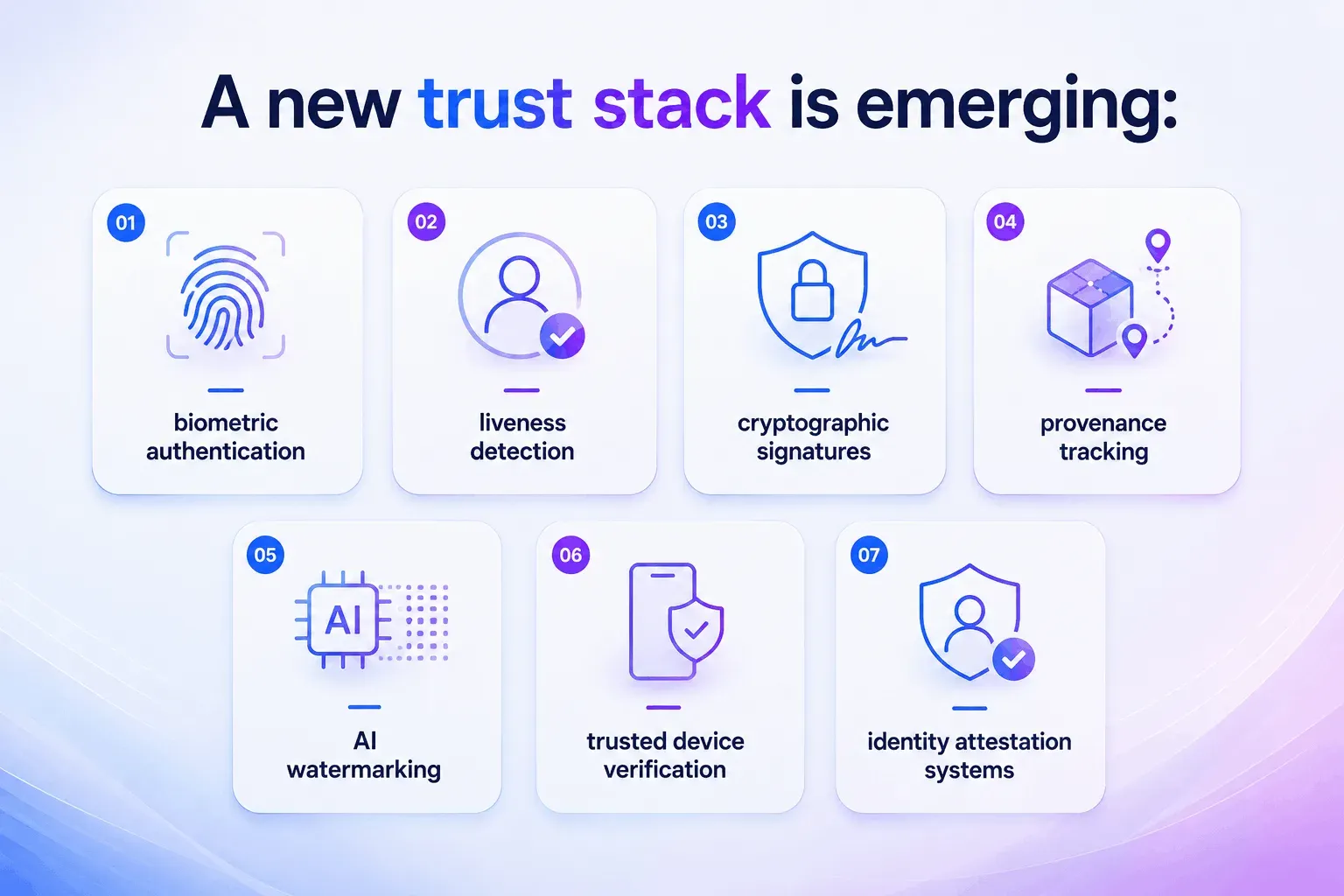
Verification is becoming a core infrastructure layer
For years, verification existed as a secondary feature: optional identity checks, account badges, multi-factor authentication, and occasional KYC flows. That model is no longer sufficient.
Verification is evolving into a foundational infrastructure layer of the digital economy.
Platforms rebuilding the internet around identity
The largest technology platforms are already adapting to this shift. Historically, internet platforms optimized for: engagement, virality, reach, frictionless participation.
Now they are increasingly optimizing for: provenance, authenticity, trusted identities, content traceability.
Verification badges are evolving from status symbols into trust indicators. Platforms are investing heavily in synthetic media detection, identity validation, and behavioral verification systems.
One of the most important emerging areas is content provenance. Companies like Adobe, Microsoft, OpenAI, and major media organizations are increasingly supporting systems that attach metadata proving:
- where content originated,
- whether AI was used,
- whether media was modified.
This reflects a major architectural shift: the internet is moving from content distribution toward authenticity validation.
Apple and Google are also quietly becoming trust infrastructure providers. Examples include: device-bound authentication, passkeys, biometric identity verification, anti-phishing systems, hardware-level trust validation.
The smartphone itself is becoming a verified identity device.
The end of the anonymous internet
AI-generated fraud creates strong incentives for governments and corporations to reduce anonymity online. That pressure is reshaping the architecture of the internet itself.
For decades, the internet operated as a relatively open and permissionless environment. Users could participate pseudonymously, create accounts freely, and distribute information with limited identity verification.
That era is beginning to erode. To combat synthetic fraud, institutions increasingly demand: stronger KYC systems, verified identities, device-level trust, behavioral monitoring, traceable user activity.
This creates a fundamental tension between security and openness. The same infrastructure that reduces AI-driven fraud also increases surveillance capacity, centralization, and platform control.
Trust becomes an economic asset
The collapse of implicit trust has direct economic consequences. When verification becomes mandatory:
- onboarding becomes slower,
- compliance costs increase,
- fraud prevention expenses rise,
- operational friction expands.
Large technology companies can absorb those costs. Smaller businesses often cannot.
This creates a new competitive dynamic where trust infrastructure itself becomes a strategic advantage.
Companies capable of proving authenticity, securing identities, and validating digital interactions gain operational leverage. Those unable to establish trusted systems face increasing regulatory exposure, fraud risk, and reputational instability.
In this environment, trust evolves from a soft brand concept into a measurable economic asset. The next generation of enterprise architecture will likely combine:
- AI systems,
- security infrastructure,
- identity verification,
- governance tooling,
- compliance automation.
Not because regulation alone demands it - but because the economics of digital distrust increasingly require it.
Conclusions
Trust infrastructure may become the next foundational technology market. As AI reduces the cost of generating content, identities, voices, and interactions, the economic value shifts toward systems capable of verifying authenticity at scale.
This creates growing demand for digital identity infrastructure, biometric authentication, provenance systems, cryptographic verification, AI-generated content labeling, behavioral trust scoring, liveness detection, communication authenticity tools.
What cloud infrastructure was to the internet economy of the 2010s, trust infrastructure may become for the AI economy of the 2030s.
Looking for help? Speak to our team!