
 Set as preferred source


According to analysts, 2026 could become a breakthrough year, defined by an unprecedented speed of change and innovation. Many of these industry trends in technology are tightly interwoven, driven largely by advances in artificial intelligence (AI) and a push for greater digital trust.
Advancements in the tech industry are reshaping the way software is created, accelerating the development cycles, enabling developers to produce software of better quality, and ensuring better alignment with the market needs.
Today, organizations feel the pressing need to adopt the latest technological advancements to stay competitive. So let's take a look at the 10 latest software development trends you need to know to avoid failure.
Why 2026 is a turning point
2026 marks a structural shift in the software industry because three independent forces converged at the same time: AI-driven development, global regulation of AI systems, and a transformation of the engineering workforce. The software industry is entering a new stage of maturity.
Software development is no longer just about building applications—it is about designing digital systems that power entire economies.
In this environment, the organizations that succeed will be those that combine strong engineering capabilities with the ability to integrate emerging technologies, adapt to regulatory changes, and continuously evolve their digital infrastructure.
For many companies, 2026 will mark the moment when software shifts from being a support function to becoming the core engine of strategic growth.
10 software development trends shaping business in 2026
Trend 1. AI-assisted development tools
The adoption of AI development tools has been extremely fast compared to previous developer technologies. Recent industry studies show:
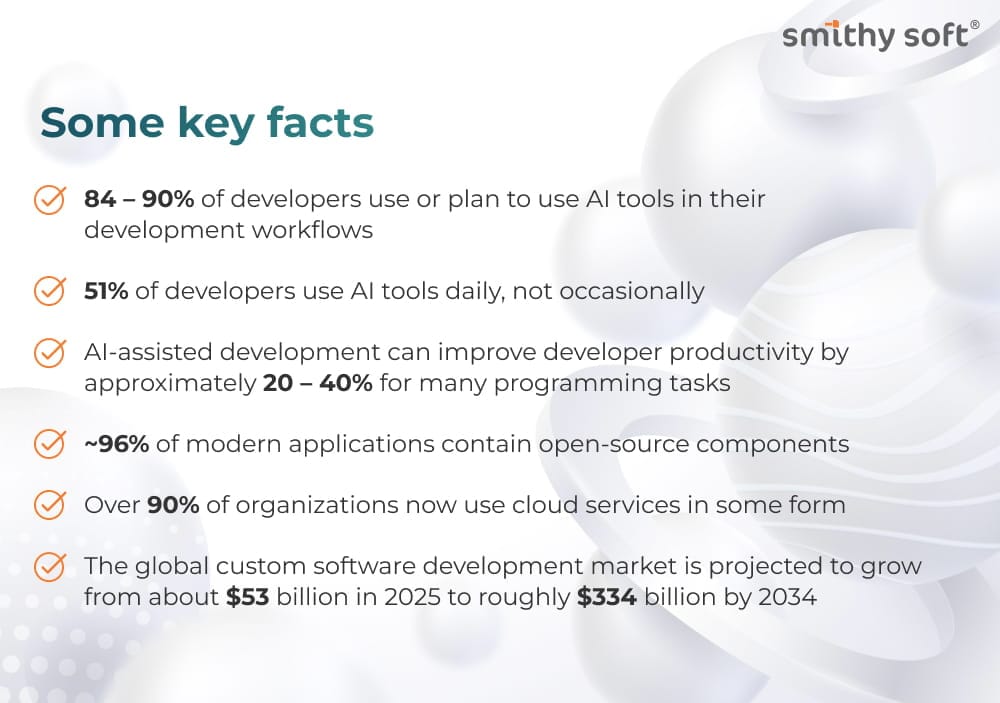
- More than 80-90% of developers now use AI coding assistants in some form.
- AI tools can generate around 40% of code in real development workflows.
- Developers using AI assistance often report productivity improvements of 25-40% for certain tasks.
These numbers indicate that AI is no longer a niche productivity experiment - it is becoming embedded in everyday software engineering practices. AI is no longer only suggesting code - it is starting to execute development tasks autonomously.
AI now writes a large share of production code. Another key difference from previous years is the volume of code generated by AI. Examples:
- GitHub Copilot generates around 46% of code written by developers on average.
- About 50% of new code at Robinhood is AI-generated.
- Developers complete tasks 55% faster when using AI assistants.
This marks the first time in software history when machines are responsible for a substantial share of new code creation.
Another major change is the appearance of AI-native development environments. Examples:
- Google Antigravity: a new AI-powered IDE designed specifically for delegating coding tasks to autonomous agents rather than writing code manually.
- Multi-agent development platforms. GitHub is building environments where multiple AI agents collaborate on development tasks simultaneously.
In 2026, AI-driven tools are mainstream in coding, testing, and design. Developers use AI “co-pilots” to generate code snippets, catch bugs, and suggest improvements, which offloads routine tasks and lets engineers focus on architecture and problem-solving. For instance, tools like GitHub Copilot, Tabnine, and ChatGPT-based assistants can write boilerplate code or automate unit tests in seconds.
Trend 2. Automation of the software development lifecycle
Automation is expanding from individual DevOps tools to automation of the entire software development lifecycle (SDLC). Instead of manually managing separate stages - coding, testing, deployment, security, and monitoring - modern teams increasingly rely on fully automated development pipelines.
Continuous integration and deployment platforms such as GitHub Actions, GitLab CI/CD, and Jenkins automatically build, test, and release software after each code update, allowing some companies to deploy new versions multiple times per day.
Testing is also becoming automated through tools like Diffblue or Mabl, which generate and maintain tests automatically. Infrastructure is increasingly managed through Infrastructure as Code platforms such as Terraform or AWS CloudFormation, enabling entire cloud environments to be created or updated in minutes.
At the same time, DevSecOps tools like Snyk or SonarQube automatically scan code for vulnerabilities before deployment, while monitoring systems such as Datadog or Prometheus detect incidents and trigger automated responses.
The result is a major shift: developers are no longer managing each stage of delivery manually but are instead designing automated systems that manage software development and deployment themselves.
Trend 3. The rise of AI agents in software development and their limits
Unlike earlier AI coding assistants that only suggested snippets of code, new systems can execute multi-step development tasks, including writing features, modifying multiple files, running tests, and submitting pull requests.
Several new tools illustrate this shift. Platforms like Devin (Cognition Labs), Cursor, and GitHub Copilot Agents are designed to operate as autonomous software agents that can take a task description - such as implementing a feature or fixing a bug - and carry it through multiple stages of development.
These agents can read documentation, navigate large repositories, generate code changes, and validate their work through testing pipelines. Early experiments show that AI agents can significantly accelerate development for well-defined tasks, particularly in areas such as bug fixing, documentation generation, and code refactoring.
However, despite rapid progress, AI agents still face important limitations. They often struggle with large-scale system architecture decisions, ambiguous requirements, and complex legacy systems where business logic is poorly documented. Another challenge is reliability: agents may fail silently, misinterpret instructions, or generate solutions that technically compile but do not meet real-world product requirements.
Because of these limitations, the role of developers is evolving rather than disappearing. Engineers increasingly act as supervisors and architects, defining tasks for AI agents, reviewing their outputs, and integrating the results into broader systems. In the near term, AI agents are best viewed not as replacements for developers, but as force multipliers that automate routine engineering work while humans remain responsible for system design, validation, and strategic decision-making.
Trend 4. Platform engineering and internal developer platforms
Many organizations are adopting platform engineering to manage the growing complexity of modern software systems. Instead of each development team independently configuring infrastructure, pipelines, and environments, companies are building Internal developer platforms (IDPs) - centralized systems that provide developers with standardized tools, services, and self-service infrastructure.
Large technology companies pioneered this approach. For example, Spotify’s Backstage platform allows developers to manage services, documentation, and infrastructure through a single internal portal. Many organizations now use Backstage or similar frameworks to build their own internal platforms.
The rise of platform engineering is driven by the increasing complexity of cloud-native architectures, which often include microservices, containers, CI/CD pipelines, and multiple cloud providers. Without internal platforms, development teams spend significant time managing infrastructure rather than building products.
Trend 5. Smaller engineering teams building more complex products
In the past, building large-scale software systems required significant engineering resources. Today, modern toolchains allow teams to move faster with fewer people. AI coding assistants, automated testing platforms, cloud infrastructure, and ready-to-use APIs reduce the amount of manual work required to build and maintain software.
APIs replace entire engineering domains. Many complex capabilities are now available as APIs:
- Stripe for payments
- Auth0 or Firebase for authentication
- Twilio for messaging and communication
- OpenAI / Anthropic APIs for AI functionality
In the past, building these systems required specialized teams. Today they can be integrated in hours.
Real-world examples illustrate this shift:
- Instagram had only 13 engineers when it was acquired by Facebook for $1B in 2012, supporting tens of millions of users.
- Many modern AI startups reach millions of users with engineering teams of fewer than 20 people, thanks to cloud infrastructure and AI tooling.
- Companies like Notion, Linear, and Vercel built highly sophisticated platforms with relatively small engineering teams compared to traditional enterprise software companies.
Success increasingly depends less on the size of the engineering organization and more on how effectively teams leverage AI tools, cloud platforms, APIs, and automation to multiply their capabilities.
Trend 6. AI-native and cloud-native architectures
Now software architecture is increasingly designed as AI-native and cloud-native from the start, rather than adding AI or cloud capabilities later. This means applications are built to run in distributed cloud environments and integrate AI models as core components of the system architecture.
Cloud-native architectures rely on technologies such as microservices, containers, Kubernetes, and serverless computing. Instead of monolithic applications, systems are composed of independent services that can scale automatically across cloud infrastructure. This allows companies to handle rapid growth, global traffic, and continuous deployment without redesigning the entire system.
At the same time, many new products are becoming AI-native - meaning AI models are embedded directly into the core functionality of the product rather than used as optional features. Applications increasingly rely on large language models, recommendation systems, and predictive analytics as fundamental system components.
Examples:
- AI copilots in productivity software such as Microsoft 365 or GitHub Copilot.
- AI-powered search and assistants integrated into applications and platforms/
- AI-driven automation systems used in customer support, marketing, and operations.
Trend 7. Security and compliance become core engineering functions
As software increasingly powers critical sectors - finance, healthcare, infrastructure, and public services - organizations face growing pressure to meet strict requirements around data protection, cybersecurity, and regulatory compliance. This has led to the widespread adoption of DevSecOps, where security practices are integrated throughout the entire development lifecycle.
In practice, this means that security checks are automated within development pipelines.
Tools such as Snyk, SonarQube, and Checkmarx scan code for vulnerabilities during development, while dependency scanners detect insecure open-source libraries before deployment. Cloud platforms also provide built-in security services for identity management, encryption, and access control.
Regulation is another key driver of this shift. Frameworks such as GDPR, SOC 2, and the EU AI Act require companies to implement strict governance over data handling, AI systems, and digital infrastructure. As a result, developers must increasingly design software that is secure, auditable, and compliant by default.
Trend 8. Data infrastructure as a core part of software products
Modern applications continuously generate large volumes of user and operational data. To manage this, organizations are building dedicated data pipelines that ingest, process, and analyze data in real time.
Technologies such as data warehouses (Snowflake, BigQuery), streaming platforms (Kafka), and data orchestration tools (Airflow, Dagster) allow teams to transform raw data into usable insights for both internal operations and product features.
This infrastructure is particularly important for AI-driven products, which depend on large datasets for training models, improving recommendations, and personalizing user experiences.
For example, platforms like Netflix and Spotify rely heavily on real-time data pipelines to power recommendation systems, while many SaaS products use embedded analytics to provide customers with operational insights.
Trend 9. Legacy system modernization
Legacy system modernization has become a strategic priority for many organizations. A significant share of enterprise software still runs on systems built 15–30 years ago, often using monolithic architectures, outdated languages, and on-premise infrastructure. While these systems remain critical for operations, they increasingly limit innovation, scalability, and security.
Several factors are driving modernization:
- Cloud migration – companies are moving legacy systems to platforms like AWS, Azure, and Google Cloud to improve scalability and reduce operational costs.
- AI and data integration – modern products require access to structured data and APIs, which many legacy systems lack.
- Security and compliance – older architectures struggle to meet modern security standards and regulations such as GDPR or SOC 2.
- Operational risk – aging systems often depend on shrinking pools of specialists and outdated infrastructure.
To address these challenges, organizations are adopting incremental modernization strategies, such as introducing APIs, breaking monoliths into microservices, and using AI tools to analyze and refactor legacy codebases. Modernization is increasingly seen not just as a technical upgrade, but as a necessary step for adopting cloud, AI, and modern digital services.
Trend 10. AI-driven product development
Instead of relying only on human analysis and manual experimentation, companies increasingly use AI systems to guide product decisions, automate features, and personalize user experiences.
One key shift is that AI is now embedded directly into products. Many modern applications include AI copilots, recommendation engines, and automated workflows that continuously learn from user behavior. Platforms such as Notion AI, GitHub Copilot, and Microsoft 365 Copilot illustrate how AI is becoming a central product feature rather than an optional add-on.
AI is also transforming how product teams work. Product managers and developers can analyze large datasets, generate feature ideas, test product hypotheses, and run experiments faster using AI-powered tools. This allows teams to iterate on product features more quickly and respond to user behavior in near real time.
As a result, companies are shifting from traditional development cycles toward AI-driven product development, where data, machine learning models, and automated insights continuously shape how products evolve.
Conclusions
Software development is entering a new phase where AI, automation, cloud infrastructure, and data platforms are reshaping how digital products are built and scaled. The trends outlined above show that development is no longer only about writing code - it is increasingly about designing and managing complex digital systems.
For businesses, this means one thing: software development is becoming faster, more automated, and more AI-driven. Companies that adapt their technology strategy and engineering processes to these changes will be better positioned to innovate and scale.
SmithySoft helps companies turn these trends into real products. Whether you need to modernize legacy systems, build AI-powered solutions, or scale cloud-native platforms, our team can help you move faster and avoid costly mistakes. Planning your next software project? Let’s talk.